An AI chatbot for website use answers visitor questions in real language, using your own content as its source, instead of forcing people through a menu of pre-written buttons. Done well, it answers pricing, hours, and product questions instantly, at any hour, and hands off to a human when the question genuinely needs one.
Done badly, it makes things up, frustrates visitors, and damages trust faster than having no chatbot at all. The difference almost always comes down to whether the bot is grounded in your real content or just improvising.
What these chatbots actually do
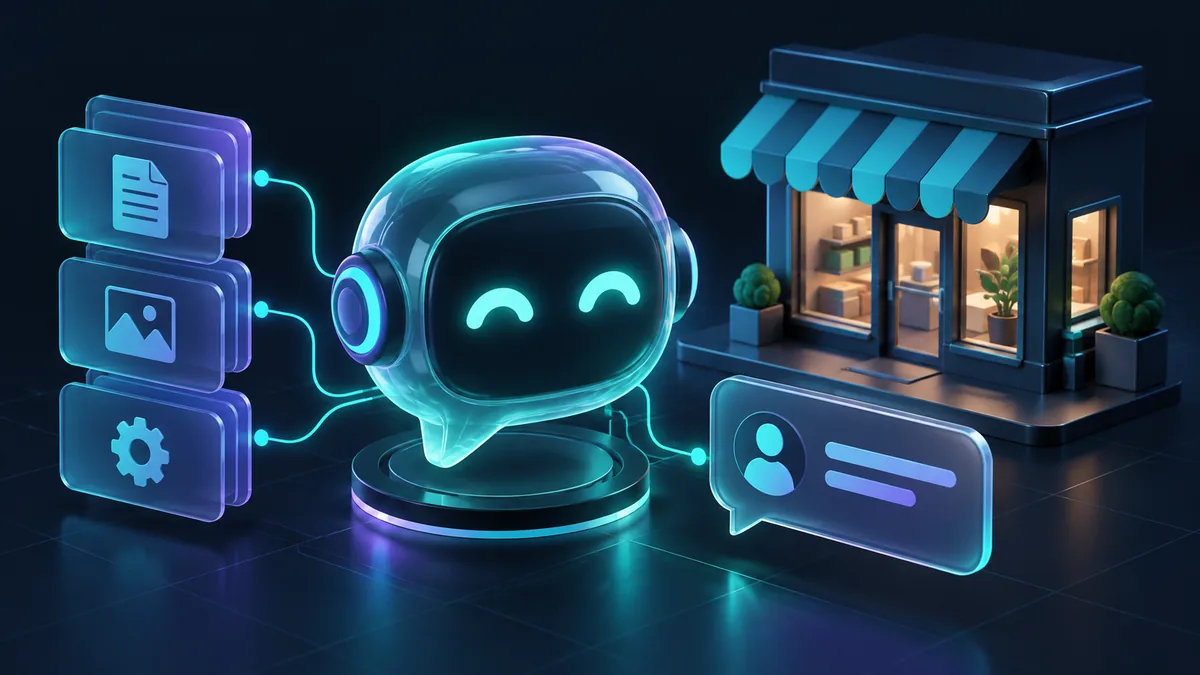
A modern AI chatbot sits on your website, reads the visitor's question in plain language, and responds conversationally. Unlike the old rule-based bots that matched keywords to scripted replies, today's bots use a language model to understand intent, phrasing, and follow-up questions the way a person would. That lets a visitor ask something oddly worded, or ask a follow-up question, and still get a useful answer.
Common jobs for one of these bots on a business site: answering FAQs about services, pricing ranges, and hours, qualifying a lead by asking a few questions before handing details to your sales team, guiding a visitor to the right page or service, and collecting contact information outside business hours so nothing falls through. It is a support and sales tool first, not a novelty.
RAG, and why it matters more than the model
The technology that keeps answers accurate is called retrieval-augmented generation, or RAG. Instead of relying purely on what a language model learned during training, a RAG chatbot first searches your own content, your pages, documents, and FAQs, for the passages relevant to the visitor's question. It then generates its answer using only that retrieved information as context.
This matters because a language model on its own will confidently answer questions it has no real information about, a problem often called hallucination. A RAG setup does not eliminate that risk completely, but it sharply reduces it, because the model is told to answer from specific retrieved text rather than from general knowledge. The practical result: a well-built RAG chatbot tells a visitor your actual return policy, your actual service list, and your actual hours, because those are the documents it was given, not a guess.
The quality of a RAG chatbot depends heavily on the quality and structure of the content it retrieves from. A chatbot fed outdated pages or thin documentation will still give weak answers, no matter how good the underlying model is. This is why building one properly means auditing and organizing your content first, not just plugging a widget into your site.
What it costs to run, in general terms
Costs break into a few categories, and they vary a lot by scale and provider, so treat these as general shapes rather than fixed numbers. There is usually a setup cost to connect the bot to your content and configure how it behaves. There is an ongoing cost per conversation or per message to the underlying language model, which scales with how much traffic the bot handles. And there may be a platform or hosting fee if you use a managed chatbot service rather than a custom build.
For most small and mid-size businesses, the running cost of a well-scoped chatbot is modest compared to the cost of a support team handling the same volume of repetitive questions. The bigger cost driver in practice is usually the setup and content work needed to make the bot actually useful, not the per-message API cost.
Where chatbots fail
- Thin or outdated source content. A RAG chatbot can only be as accurate as what it retrieves from, so a site with sparse or stale pages produces a bot that gives vague or wrong answers.
- Overpromising scope. A bot trained on your service pages should not be asked to give legal, medical, or financial advice, or to make commitments like pricing guarantees it is not authorized to make.
- No human fallback. Visitors get frustrated fast when a bot loops on the same non-answer with no way to reach a person. A good setup always has an escape hatch to a human or a contact form.
- Poor placement and tone. A bot that interrupts every page load or answers in a mismatched tone for your brand does more harm than a plain contact form.
Building versus buying
Most businesses do not need to build a RAG pipeline from scratch. A range of platforms now let you connect your website content and documents and get a working chatbot without writing retrieval code yourself. That path is faster and usually cheaper for a straightforward FAQ and lead-capture bot.
Custom development earns its cost when your requirements go past a standard FAQ bot: when the bot needs to check something in your own systems, follow a specific qualification flow for leads, match a particular brand voice closely, or integrate with tools your business already runs on, like a booking system or a CRM. A platform bot is a reasonable starting point for testing whether a chatbot helps your business at all. A custom build is the right move once you know it does and want it doing more.
Measuring whether it is actually working
Do not judge a chatbot by how clever its answers sound in a demo. Judge it by whether it reduces repetitive questions reaching your team, whether visitors who use it convert or contact you at a similar or better rate than those who do not, and whether the transcripts show it staying accurate and handing off appropriately when it should. Review a sample of real conversations regularly, especially in the first months, since that is where you catch a bot confidently answering something it should have deferred on.
How this compares to a full AI agent
A chatbot answers questions. It does not usually take action on its own, like updating a record, checking real-time inventory, or completing a multi-step task across systems. That is a different and more capable category, an AI agent, and we cover the real distinction and when it is worth the extra complexity in a separate guide on AI agents versus chatbots. Most businesses starting out should get a well-built chatbot right first.
Getting started the right way
Start by identifying the 10 to 20 questions your team answers most often by email, phone, or live chat. Those are exactly what a RAG chatbot should be trained on first. Make sure the source content those answers come from is accurate and current, because that becomes the bot's entire knowledge base. Set a clear boundary for what the bot should hand off to a human, and test it with real questions from people outside your team before it goes live, since they will phrase things your team never would.
If you want a chatbot built on your actual content, with a clear scope and a human fallback that works, see our AI chatbot service or our broader AI integration work, and reach out to talk through what your visitors actually ask.